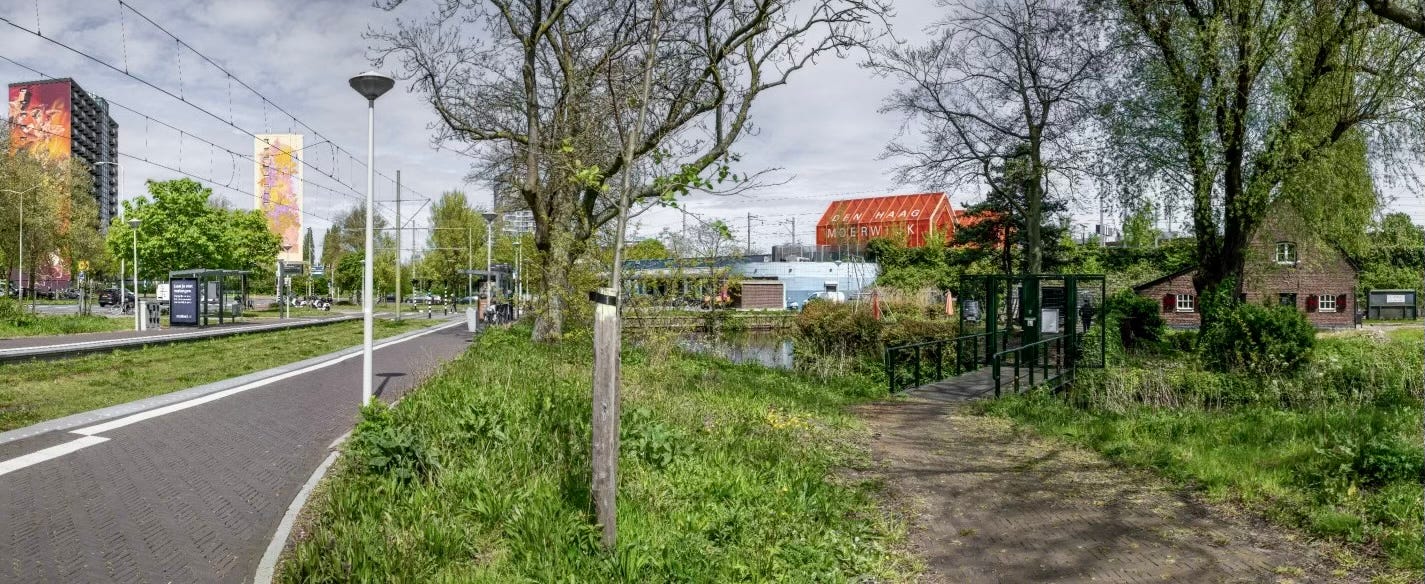
Southwest, The Hague
We lived in the same city, an 11 minute drive or a 36 minute walk away. When we first met, I had no idea we lived in different worlds.

We lived in the same city, an 11 minute drive or a 36 minute walk away. When we first met, I had no idea we lived in different worlds.
The signs were there of course. She was blue collar, I was of the white variety and had just completed my Masters degree, but we worked for the same company, on the same floor.
She asked me where I lived.
Den Haag, I said, using the Dutch word for The Hague.
Oh, me too, she replied.
Did you also take the new Intercity here? I asked. The new ones are always delayed, I added, rolling my eyes.
No, I always take the Sprinter. I live in Moerwijk, she replied.
Although I prided myself on knowing The Hague well, curiously I’d never heard of Moerwijk. I couldn’t place it on an internal map I had, the one I took note of (cool, trendy) restaurants or businesses, except now I could assume it was generally on the same plane as the train going from The Hague to Rotterdam.
I lived in the centre anyways — where the best of the city was at my doorstep. Independent cinemas, a newly-built concert hall, and big box stores stood in and alongside centuries-old buildings with cozy small cafés, large museums, and boutique fitness studios.
I could tell from her eager eyes that she wanted to be friends with me, dark brown doe eyes widening when she spoke excitedly. That, and I’d stroll past her desk a few days a week to talk to a male middle manager at the corner office. Each stroll would illicit an excited wave from her side, a courteous smile from mine.
The male middle manager was a stakeholder, and later, a friend. He and I had bonded over our shared passion for nature, traveling, living in centuries old historic houses, and being in-the-know of all the restaurants in our respective cities.
Nonetheless, I was young. She was young. But the differences in my eyes were apparent.
I enjoyed controlling our conversations — letting her speak, never saying too much of myself. She wasn’t a friend. She was a source.
You see, it was merely part of my job to source gossip from all parts of the organisation. I’d report back any murmurs and discontent to the leadership team.
Her perspective was important, and equally so was the perspective of a n-2 manager in Dubai, as was the perspective of a veteran customer service supervisor in Singapore.
I joined her and her blue collar colleagues a few times on their lunch breaks. Strolling through a muddy park nearby, she once told me of a recent trip to Paris over the weekend. She’d taken the bus in what I’d assume was a mind-numbing 8 hour route there.
It was cheaper, she said. Around 20 euros. And the bus has wifi. You should try it sometime, she urged me.
I nodded and smiled in response.
With my questions prodding her along, I kept my mouth shut on the number of times I’d gone to Paris, sitting in plush red first-class chairs, with the admittedly faster high-speed train that cost more than 20 euros. Because it wasn’t lying was it, if it was just letting the other person speak?
She stayed in a hostel 30 minutes outside of the centre. She’d walk every morning 12 minutes to take a 30 minute metro ride into the city to get breakfast from a hyper-trendy bakery, of which the croissant would eventually be posted to her instagram.
How cool, I’d add, along with a chorus of oh really’s, and uh-huh’s.
I didn’t mention staying in Saint-Germain-des-Prés where I’d be greeted every morning by the hotel staff knocking on my door with a large wooden tray. Pastries, French yogurt, orange juice, freshly cut fruit, a bowl of cornflakes, and a silver pot of coffee with accompanying porcelain cups all laid out pleasingly. The basket of pastries best used for their aesthetic purposes.
I mean, it’s not like a butler with white gloves wheeled in my breakfast on a silver rolling cart and unveiled the organic yogurt with a cloche. It was just a wooden tray.
Paris — that’s where she bought her Louis Vuitton monogrammed canvas pochette. The same bag she now flaunted in every instagram picture of herself. I could sense she was proud of it, so I think it must not have been a fake — it was only a thousand or so anyways.
When I messaged her on Teams that I was leaving the job, she asked for my instagram. I said sure, and gave her my handle and followed her back. She asked me to meet, and I said, sure, but never followed up.
On my instagram, littered with my travel diaries throughout Paris, the Caribbean, and Asia, I wondered if she had seen the side of myself I had concealed in an effort to seem more relatable to her.
But last week I saw her at a mom-and-pop Japanese restaurant on a Saturday night. I’d braved the few minutes of bone chilling wind and walked there — I was searching for a new Japanese restaurant in the neighbourhood to become a regular at after my old joint had been sold.
I wore a bag I wasn’t precious about. I didn’t bother with my hair either.
But she did. And she ate leaning over the table with her left hand nudging her honey-highlighted hair back as she held the chopsticks in her right hand. She was two tables over with a guy I assumed was her boyfriend. He sat on the couch side of the table, whilst she sat on the chair with her Louis Vuitton pochette dangling from the front armrest of the chair where she could always see it.
They’d ordered shrimp tempura, two rolls, diet cokes, spoke softly, and kept to themselves. The chain of the Louis Vuitton pochette glimmering periodically as it swayed along the arm of the chair, the reflected ray of light flickering across the white tokkuri my sake was served in.
We didn’t acknowledge each other and I’m not sure she recognised me, but I thought of her for the first time in 18 months.
And I thought about how I’d concealed parts of myself to get closer to her, so she’d spill the tea that I’d distill back to the leadership team. And I’ve learned since to not sell my soul to bullies claiming to be leaders, but I wonder if she eventually learned what I had done with the work-related gossip she told me in confidence and ignorance.
The following Thursday in the last week of November, I offered to accompany my boyfriend on an excursion first to Rotterdam to pick up a package from an obscure pinball parts seller. Afterwards we headed off to an address in the southwest of The Hague to pick up metal pieces he had dropped off weeks ago to be cleaned and refinished.
I hadn’t been to the southwest of The Hague, but at the newly-built concert hall, I had come across an exhibition displaying posters of locals living in the Southwest, humans-of-New-York-style. One of a social worker read, “I want people from this neighbourhood to know that they too can be superheroes.”
The company in the southwest was one my boyfriend knew well — they created custom roof racks for cars, but he knew the brother-and-sister duo owners would also help him remove rust from small metal pieces for a nominal fee.
The sister welcomed us warmly in a rich plat Haags accent. On the front counter they had a bowl laid out with chocolate covered kruidnoten, and we made small talk about eating the contents of the bowl.
I can’t even look at them an anymore, she said. Once I start, I never stop.
Picking out two covered in dark chocolate, I savoured the taste of the spiced cookies - my first sample of the season.
In the waiting area just beyond the front desk, a life-size statue of a man held out a silver tray which they filled with haagse hopjes. Eerie and kitsch, I remarked that if I had a business like that in the future, I’d have a similar offering.
I paid in cash, their preferred method, and we left sans receipt through the garage door with the beautifully de-rusted pinball pieces.
As we left the street, I realised how different this neighbourhood looked. I had been lamenting recently that all the neighbourhoods in The Hague were starting to look alike with Albert Heijns every 300 meters, but this area was far from it.
We had driven ten minutes along apartments on a large road, passing by a bare-bones gym, a sleek McDonalds, but no Albert Heijns. Self-storage facilities and dilapidated two story business parks formed from blocks of grey, white, and dirty creams occupied the inner streets instead.
On the left hand side of the street, four-story apartment residences built in the 70s rose from the concrete. Desolate dirty cream bricks held the foundation of the flats above, with the bricks wrapping the windows of glass as fingers curling upwards holding a box would.
Each apartment had cookie-cutter French doors and a gated balcony the length of an arm’s span. One resident placed a single foldable camping chair in the balcony (two couldn’t possibly fit), another placed a hip-height yellowing plant, but most left the small space empty.
I wonder if the building had been cool in the 70s.
As we drove along the road, the height of the buildings grew, as did their brutality. Four-story projects became ten-story blocks with views overlooking other cloned housing projects.
Uniform brutalist concrete buildings pierced through the greying sky with their hard edges, each punctuated by window grids all the same size.
The streets lined with parked cars were grey, the buildings were grey, and I tried to wrap my head around the fact that that this was the same city I lived in and claimed to love.
Another block of four story apartment building came into view on the left. These must have been slightly newer, or they were just cleaner. The plain facades were plastered with a greyish-cream, again with uniform windows of all the same shape and size. It was The Hague, but it could have also been Poland.
These too had a small balcony, although I think you could fit two foldable camping chairs on it. The apartment building ran the entire large block, just endless cookie cutter facades one after the other.
Although arguably better than a block away, I shuddered to think what it must be like to live there — where the facade of your house — no, apartment — looks exactly the same as your neighbours, where the greenery is sparse, and a large street with much through traffic overlooks your one large living room window.
At the end of the street we come across to a t-junction where we’d eventually make a right turn to head back to the city centre.
Towards the right there was a railway station. With a snack bar below and bikes littered up front, it was there where I saw a bright orange glasshouse. Situated between the train tracks, and in large capital letters on the sloped orange roof, the white letters spelled out Moerwijk.