
Great female artists we don’t talk about: Jacoba van Heemskerck
Review of Alles Gegeven at Kunstmuseum Den Haag: 4.4 out of 5 stars.

Alles Gegeven (Everything Given) is an inspiring exhibition that provides a major overview of the work by Dutch artist Jacoba van Heemskerck, with particular attention to her relationship with art collector, Marie Tak van Poortvliet. Using both the collection of Museum Boijmans Van Beuningen and Kunstmuseum Den Haag, the exhibition adequately showcases how Heemskerck’s avant-garde art evolved with her personal and spiritual life.
For a world that is increasingly materialistic, the exhibition uses Van Heemskerck’s art to highlight how rich our own lives can be when we embrace great abstract values.
Early Foundations
Van Heemskerck was born in 1876, at the cusp of modernity to an aristocratic family in The Hague. Her father, Jacob Eduard van Heemskerck, was a naval officer who painted and taught her how to paint. At age 21, Van Heemskerck was further educated at The Royal Academy of Arts (KABK) in The Hague.
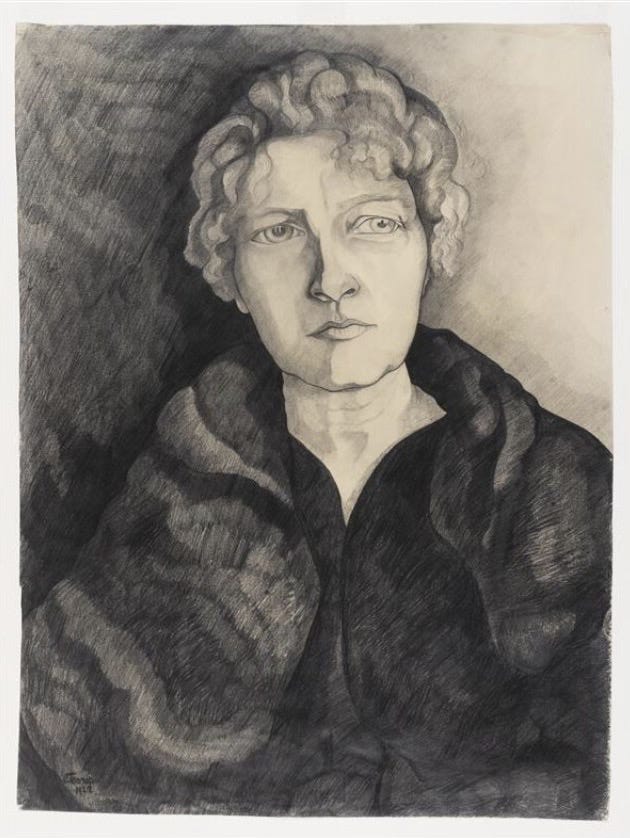
During Van Heemskerck’s active years, the first wave of feminism had begun to take shape. Middle-class Dutch women began gaining paid employment in the mid 1800s, KABK had began to accept female students in 1872, and the first birth control clinic opened in 1882. However, women were still beset by misogynistic norms and institutions. Throughout her life, Van Heemskerck would defy norms in painting, creating avant-garde art and within her life with her relationship with Marie Tak van Poortvliet.
Relationship with Marie Tak van Poortvliet
Essential to understanding Van Heemskerck is Marie Tak van Poortvliet, a friend, art collector, and later, life-long companion. They both hailed from wealthy families in The Hague and attempted to place themselves in the world of Dutch avant-garde — Van Heemskerck using her painting talents and Tak Van Poortvliet by using her capital to purchase art and fund the scene.
Armed with a considerable inheritance, Tak Van Poortvliet built an artist colony in Domberg, Texel, where she invited avant-garde artists to work. Known visitors included influential living artists Piet Mondrian and Jan Toorop. By inviting Van Heemskerck to reside at Domberg, Van Heemskerck became well-connected and increasingly known in the Dutch avant-garde scene.
Luminism & Cubism
In her early career, Van Heemskerck’s style echos these aforementioned prominent painters and their post-impressionist styles. Notably, she created Luminist depictions of trees. Inspired by French pointillism. she paid particular attention to the effects of light using the juxtaposition of colours.
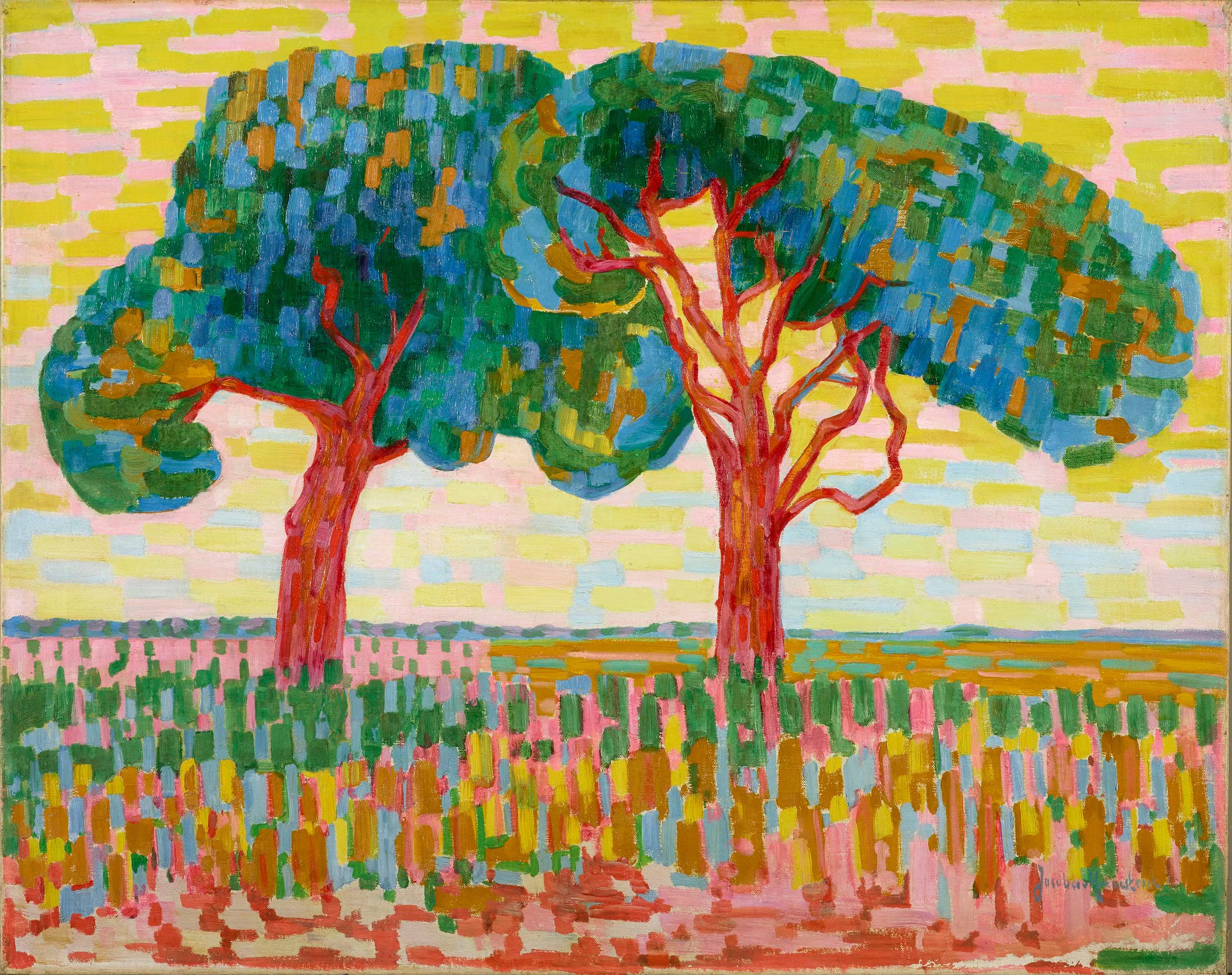
A standout is Two Trees (1910). In amongst the pale yellow walls of the exhibition hall, the colour of the red tree trunks shine, painted from mixed maroons and lilac restrained brushstrokes of uncertainty. Set against the horizontal strokes of distinct pale pinks, soft yellows, and baby blues, the red trunks pulsate with life, doubt, amidst the etherial hues. A crown of cornflower and sapphire blues and earthy greens sit above the trunks, their colours, strokes, and energy emanating from trees of life. It’s a symbol that she would ofter refer back to in her work — the trees of life.
In 1911, Van Heemskerck was exposed to Cubism at an exhibition in Amsterdam. Later at Domberg, she takes lessons with prominent Cubist artist of the time, Lodewijk Schelfhout. Subsequently, her style shifts and she experiments with limited palettes and emphasized geometric forms. Hues of grays and browns begin to take over her canvases, displacing the previous bright hues. The change is striking and Schelfhout would later accuse Van Heemskerck of plagiarizing his style.


Relationship with Piet Mondrian
Contemporary art historians claim Van Heemskerck’s work cannot be viewed in isolation from the work of Piet Mondrian. Indeed, their artistic styles evolve similarly. Before settling on De Stijl and expressionism, both artists show themselves to be restless stylistically as they oft incorporated innovative painting trends before their great departure into creating their unique styles.
Mondrian and Van Heemskerck move quickly from Luminism to Cubism between 1908 to 1913, shifting from bright hues to muted earthy tones. Afterwards, taking inspiration from Impressionism and Fauvism, paired with their common interest in new spiritual movements, their art becomes increasingly abstract. Stifled by the conservative Dutch scene, both artists eventually recognise their artistic development would need to occur outside of the Netherlands — Mondrian in Paris, and Van Heemskerck in Berlin.


We know Mondrian and Van Heemskerck were well acquainted. According to Tak Van Poortvliet, Mondrian and Van Heemskerck would sketch together at Domberg, often drawing trees. In 1910, Mondrian would also include Van Heemskerck’s work alongside his own in an avant-garde exhibition at the Stedelijk Museum Amsterdam, placing her work alongside his own and well-known artists Jan Toorop and Jan Sluijters.
The inclusion of Van Heemskerck in the exhibition, was not without criticism, however. Sluijters went as far as to refuse that his work be shown in the same hall as Van Heemskerck’s, on the basis that she was a woman, and therefore, her work was amateurish and not serious enough.


Further, Mondrian and Van Heemskerck were interested in the new spiritual movements in the early to mid-twentieth century. As Van Heemskerck, Mondrian saw his art tied to larger spiritual forces. In his notebook, Mondrian writes, “one sees in art the slow growth towards the spiritual, while the creators are unaware of it. The conscious way of teaching suffers most from its corruption in art. If these two paths go together, i.e. the creator is on the step of evolution where the conscious spiritually direct work activity is possible, then one has the ideal art.”
Coming Into Her Own
During her greatest artistic years, Van Heemskerck strived towards creating “a study of all that which nature contains spiritual worth, of all that life can teach us of its deep meaning and of the way in which these two factors have an influence on each other.”
And it is in the late 1910s with increasingly abstract art that Van Heemskerck comes into her own. With spirituality at the forefront of her mind, she creates paintings and glasswork with deeply rich colours interweaving amongst each other. These colours and forms become a force displaying powerful emotional turbulence and serene flows and with it she creates her own nameless style of expressionism.


The exhibition displays the artist’s first foray into abstract art, Composition (1914). A cloudy image displaying restrained short brushstrokes reminiscent of Fauvist techniques. Hung next to Kadinsky’s work from an earlier year, her work echos his (as does the title) with soft contours where shape and colour meet. Here, early on, you can see the beginnings of what would eventually make up Van Heemskerck’s signature style with her chosen color palette and thin black lines flowing serenely throughout the canvas.
Two Notable Paintings
Bild No. 87 (1918) depicts a purple tree with meandering branches at the foreground. The purple branches fill the canvas, nudging the top and while remaining connected to its’ roots at the base. Around the tree, meandering playful lines of mossy greens, burnt oranges, gold, and blacks interplay, suggesting dynamic movement. A hemisphere of marine blues fill the bottom half of the canvas, balanced by lighter golden hues atop. It is a painting of a tree and it is also far from it.
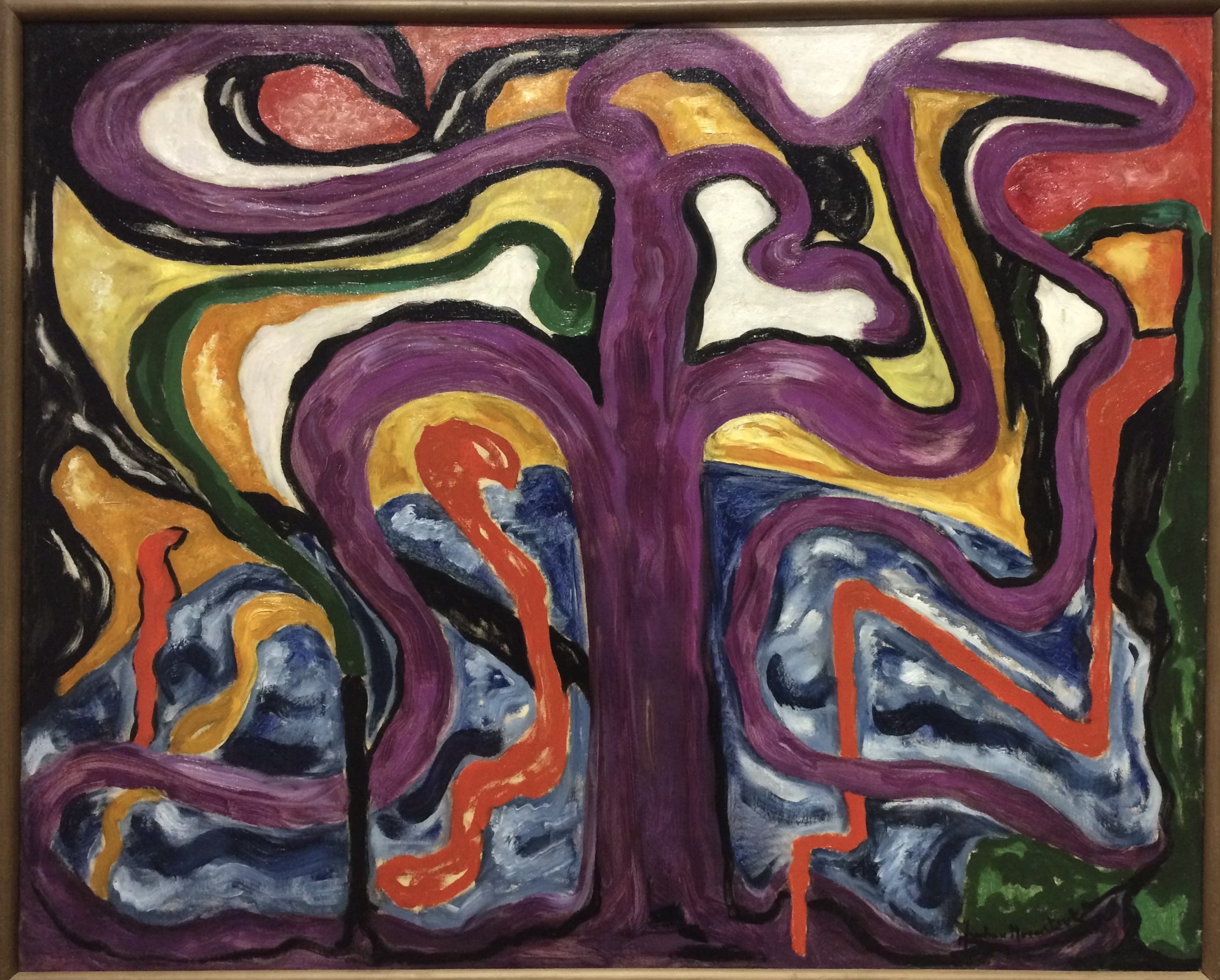
With distinct colours, shapes, and lines, the painting inherently solicits a response — is it an uneasiness? Or does it portray discomfort? Is it primal? What of harmony and spiritual-inclination? It is up to the viewer to decide.
In Color Composition No. 106 (1919), set against a dark purple backdrop, Van Heemskerck paints two trees, painted with billowing dark lines curving upwards stemming from darker thicker lines down below. These dark lines at the foreground juxtapose three smaller towers, enlightened with glowing yellow hues in the centre of the work. The light emanates clearly from a distance, like light at the end of the tunnel, probably representing the divine origins of life — a symbol she would often make use of.
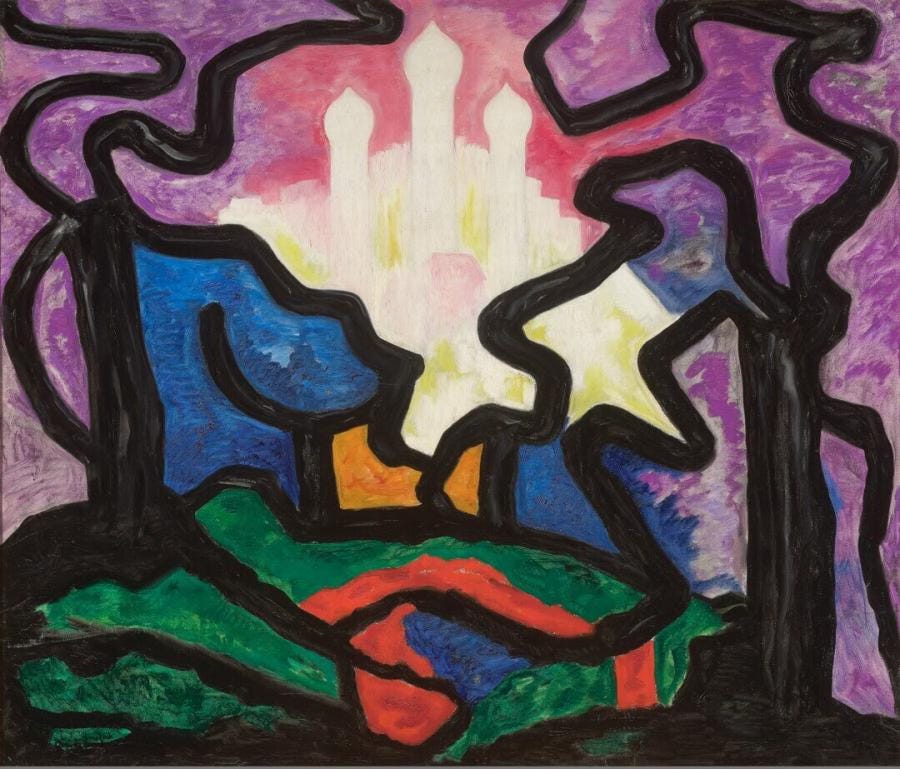
It struck me profoundly. Van Heemskerck perhaps meant it to be reference to nature and spirituality and God. But as Barthes points out, the author is dead.
In my perspective, the message was clear: there was terrible beauty and death on earth. But yonder, just yonder, there is magnificent hope.
How We Talk About Van Heemskerck, Then and Now
The Kunstmuseum’s Alles Gegeven exhibition touches upon relevant topics today, namely feminism, innovation, and sustainability, not all of which were mentioned in this review. However, it is worth noting that the exhibition (and ergo, this piece) places Van Heemskerck’s interpersonal relationships as a defining narrative of her art.
It is as though it is these people — Tak van Poortvliet, Mondrian, Toorop, Sluijters, and others — that give her art relevancy. It is as though her art and the narrations we give it cannot stand on their own.
When we discuss Van Heemskerck, we mention Mondrian, but when we discuss Mondrian, there is little (if at all) acknowledgement of Van Heemskerck or Tak van Poortvliet. And it is unfortunately common that we write men into stories of women and cast shadows on women in the stories of men. There is seemingly a tendency of institutions of art history to write and re-write history in manners that amplify male artists and forget female artists of the same period.
Art history is always tied to political, economic, and social institutions of the time and as with Van Heemskerck, we still live in societies where men are the default. At the turn of the 20th century, this male dominance of (formal and informal) institutions meant men overwhelmingly curated exhibitions and female artists experienced belittling and exclusion on the basis of their sex.
A hundred years later, we see more representation of female artists in great museum halls, and yet, female-created works still only make up a scant portion of their collections. (Only 5-6% of the Kunstmuseum’s collection is made by women, according to current director Margriet Schavemaker.)
Rather than the art of Van Heemskerck to be discussed by her own merit, instead we refer back to “great” men to understand the narratives we tell about her. Given the limited resources on Van Heemskerck, it is unclear whether it’s even possible now to get meaningful public engagement on the exhibition without falling into this trap.
Ultimately, Van Heemskerck’s abstract art is increasingly relevant in today’s materialistic society and their connections to deeper forces bring themselves great insights. I laud the Kunstmuseum for bringing together a poignant exhibition on Van Heemskerck, telling a holistic narrative of her life and making visible the influences that shaped her life and art.
It is a shame that we do not discuss her art without interjecting other male artists into the conversation. But yonder, just yonder, perhaps there is hope.
Alles Gegeven is on view at Kunstmuseum Den Haag from July 5th, 2025 until March 1, 2026.
The Hague Review: 4.4/5 stars
See Also
Book: Jacoba van Heemskerck, Truly Modern (2021), edited by Luisa Pauline Fink, Sebastian Möllers, Henrike Mund and Christina Végh
Book: Alles Gegeven (2025) by Jacqueline van Paaschen (in Dutch)
Book: On the Spirituality in Art (1912) by Wassily Kadinsky
Book: Complete Mondrian (2001) by Marty Bax
Article: “Alleen maar vrouwelijke kunstenaars tentoonstellen corrigeert de canon niet” (2024) by Toef Jaeger, NRC. https://www.nrc.nl/nieuws/2024/10/02/alleen-maar-vrouwelijke-kunstenaars-tentoonstellen-corrigeert-de-canon-niet-a4867926 (in Dutch)
Essay: Why Have There Been No Great Women Artists (1971) by Linda Nochlin
Podcast: “Aflevering 8 - Margriet Schavemaker” (2024) Feminist?! A New Look by Kunstmuseum Den Haag